Stem and Leaf plots give quick representations of data and the distribution, shape, and density of that data. This plot shows the ages of family members attending a family reunion. For example, the youngest age recorded was 1 year old and the oldest age recorded was 81 years old.
Sunday, October 23, 2011
Box Plot
A box plot graphs data into 5 summaries. These are: the smallest observation, lower quartile (Q1), median (Q2), upper quartile (Q3), and largest observation. The three quartiles are distinguishable by their box and the end points represent either the smallest or largest observation.
Histogram
http://tstahley.wikispaces.com/Math+Dictionary
Histograms are mainly used to show the distribution of data. Variables are arranged on an x-axis and a y-axis. This example shows the number of employees a business has and the average salary the employees make. You can interpret the graph by saying that the more employees a company has, the less money on average a given employee makes compared to companies of smaller size.
Parallel Coordinate Graph
http://andrewgelman.com/2007/10/parallel_coordi/
These graphs display a group of lines that contain a set of points and are separated by equally-spaced vertical lines. This example is from Alfred Inselberg. He was the one who proposed that this type of coordinate system could be used in visual data mining, air traffic control, and interactive models of other systems.
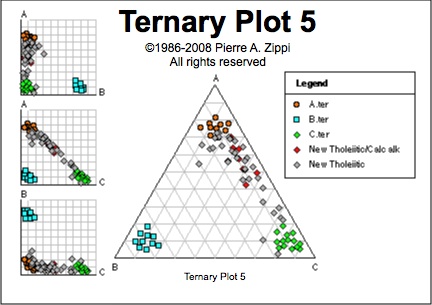
Triangular Plot
Triangular plots show ratios of three different variables and they all are positioned on a equilateral triangle. This example is plotted in three bivariate cross plots where means and standard deviations are calculated.
Windrose
A windrose is used to graph the weather conditions, wind speed, and direction of a certain location. This one shows a relatively strong easterly wind. The different colored bands represent the wind ranges.
Climograph
These graphs are used to show the climate and precipitation of a certain area. This particular climograph shows temperature and precipitation levels in Guam over a given year. The precipitation levels were generally varied and the temperature remained around the same throughout the year.
Population Profile
http://camellia.shc.edu/literacy/tablesversion/assignments/statisticsassign.htm
A population profile like this one is used to describe a population in a specific area. For example, this map is from Mobile County and describes the population growth. The darker blue stands for males and the lighter blue for females.The average age of the population is around 40-44 years old.
Scatterplot
Scatterplots plot points between two axes and are used to extrapolate data from two or more variables. They also show the relationship between the variables and how one would be affected by the other(s). That relationship is called correlation. This scatterplot shows the correlation between height and weight.
Index Value Plot
http://www.epa.gov/air/data/help/hmonaqi.html
Index value plots show an index of values instead of definitive measurements. This index value plot is measuring the quality of air based on the amount of pollutants in it.
Saturday, October 22, 2011
Accumulated Line Graph or Lorenz Curve
http://www.unc.edu/depts/econ/byrns_web/Economicae/Figures/Lorenz.htm
An accumulative line graph, otherwise known as a Lorenz curve, is a graph that depicts a degree of inequality between two distributions. The value that is measured to find the level of inequality is the slope. The Lorenz Curve combines the data from both categories so it is a good and accurate measurement of determining whether or not the graph is increasing or decreasing.
Bilateral Graph
These graphs compare at least two different variables side to side. It is very similar to a bar graph. The x-axis in this graph represents fiscal years and the y-axis represents the number of people. The data being measured is the acceptance of trainees, the dispatch of experts, and the dispatch of JOCVs.
Nominal Area Choropleth Map
http://geoportal.icimod.org/TrainingandEducation/GISforBeginners/p1ch8/
These types of maps show quantitative differences for variables. The nominal data is used to display the information. This type of map uses properties that are constant in order to avoid errors.
Unstandardized Choropleth Map
This is an example of an unstandardized choropleth map because it uses raw values for the data. It represents fertility rates in the world from 2000-2005. The darker areas account for areas of higher fertility rates and vice versa.
Standardized Choropleth Map
1.
These maps are used to compare the distribution throughout an area. This map is of Canada and shows the population of 14 year olds and younger throughout the country. Darker shading represents a higher concentration of that younger generation and lighter shading represents older generations.
Subscribe to:
Comments (Atom)